
ID systems
LIBERTY’S POSITION ON DIGITAL ID
Posted on 24 Sep 2025
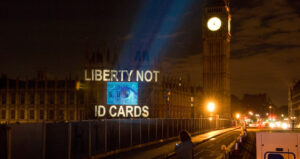
Next year will mark the twentieth anniversary of Tony Blair’s Identity Cards Act. The scheme was hotly debated for almost a decade, cost over £250 million, and was promptly abandoned by the following government. The conversation surrounding Blair’s scheme would look eerily familiar to anyone who has read the papers in the last year. The ID cards of the 2000s were a policy silver bullet, championed in the various battles against terrorism, welfare fraud, and immigration depending on the issue of the day. The scheme proposed to retain biometric data and track every use of the ID in a central database. It collapsed under the weight of its expense and controversy.
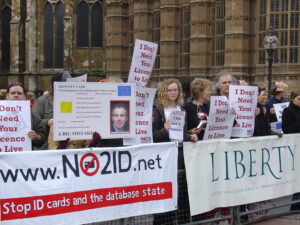
Liberty was a key member of the NO2ID Coalition that led the fight against Blair’s ID scheme. As Labour reportedly readies itself to announce another ID scheme, Liberty must consider what has changed and what has not. The world has transformed since the 2000s. Much more of our lives now takes place online. Huge swathes of the state are digitised, including our health service, housing, and welfare access. In a world of online shopping, banking, and streaming, proving who we are in a safe and secure way has become a vital need. The case for a trusted form of digital ID, which can help us access digital public services and prove who we are online, has shifted.
However, the human rights concerns associated with such a scheme have not. The extent of these risks and the opportunities of a digital ID system entirely depend on the policy choices the government makes.
Liberty has long opposed the introduction of compulsory identity cards. A compulsory system would fundamentally change the relationship between individual and state. It would also exclude the most vulnerable members of our society. Government research ahead of introducing voter ID requirements found more than 2 million UK voters lacked appropriate photo identification.1 This would be compounded by digital exclusion in the case of digital ID. Four per cent of Britons, 2.1 million people, are offline according to a report by the House of Lords Communications and Digital Committee.2 3Poverty is a key predictor of digital exclusion, as is old age. We must always retain the right to verify our identity offline to limit the harms of this digital exclusion.
Technological advancements mean that digital ID systems pose an even greater risk to privacy than they did when last proposed in the 2000s. A single and unique ‘digital identity’ and centralising databases would remove much of the individual’s agency in managing their data. This information could be used to profile individuals across multiple datasets and would pose particular risks to marginalised communities (such as those unknowingly included in police databases).4
A digital ID system designed to reduce irregular migration would be plagued by the above human rights and discriminatory problems. It would likely be mandatory, give the Home Office huge surveillance powers over our lives (including our interactions with our employers, landlords, and public services), and would make migrants lives even more difficult and dangerous. There are many countries that have mandatory ID systems, and it’s been shown there is no clear correlation between irregular migrant population, underground economies and ID policies. Before doubling down on this cruel and ineffective approach, the government should analyse how digital ID has worked elsewhere and examine if the supposed benefits in reducing migration stand up to scrutiny before rushing to introduce it here.
David Eaves, a digital government expert, recommends that ‘digital technologies are harnessed by the state to focus on the creation of public good and support individual liberty.’5 Liberty supports a digital identification system that meets these aims. Such a system would need robust human rights safeguards, adhere to the strictest data privacy and security standards, retain minimal user data, establish firewalls around sensitive state databases, be unlinkable (i.e. making it impossible to link different transactions or functions carried out by a user), and be voluntary.
The UK will benefit from not being first movers in this space; we now have examples of technology, policy design, and safeguards from around the world to draw upon – including the EU’s new system.
Liberty awaits the Government’s proposals. We hope that the Government learns from both the mistakes of the 2000s and the good work done in Europe and beyond to research and build rights-respecting ID systems. Digital ID could be an essential tool for every digital citizen, or a nightmarish surveillance system – we’ll be following how Labour takes forward their plans, ready to respond and make the case for a human rights respecting system.
- Cabinet Office, ‘Voter identification: photographic ID ownership in Great Britain’, Gov.uk, 11 May 2021.
- House of Lords Communications and Digital Committee, ‘Digital exclusion in the UK: Communications and Digital Committee report’, House of Lords Library website, 30 January 2024.
- Ibid.
- Anthony France, ‘Met Police’s new gang database still “racist” for targeting young black Londonders, claims charity’, The Standard, 20 February 2025.
- David Eaves, ‘The Narrow Corridor and the Future of Digital Government’, UCL Institute for Innovation and Public Purpose, 30 August 2024.
I'm looking for advice on this
Did you know Liberty offers free human rights legal advice?
What are my rights on this?
Find out more about your rights and how the Human Rights Act protects them
Did you find this content useful?
Help us make our content even better by letting us know whether you found this page useful or not